
Three Ways Backends Talk: REST, gRPC, and SignalR Explained Like You’re New to Backend Development

When someone starts learning backend development, there’s a moment of confusion that almost everyone experiences. You build some logic on the server, but then you ask yourself:
“How does my frontend, mobile app, or another backend actually talk to this server?”
Very soon, you hear words like REST, gRPC, and SignalR being used casually in meetings, tutorials, and job descriptions. People say things like:
“Expose a REST API”
“Use gRPC for internal services”
“SignalR will handle real-time updates”
For content overview videos
https://www.youtube.com/@DotNetFullstackDev
For someone new, these sound like advanced, unrelated technologies.
But in reality, they are simply different ways of solving the same core problem — communication.
This article explains what these are, why they exist, why only these three dominate most backend systems, and whether other options exist, all in a slow, story-like manner.
First, the core idea (before protocols)
Before we talk about REST, gRPC, or SignalR, we must understand one foundational truth of backend systems.
A backend is rarely alone.
It almost always needs to communicate with something else:
a web browser
a mobile application
another backend service
a dashboard
an external system
These systems are:
running on different machines
connected through networks
possibly written in different programming languages
possibly maintained by different teams
Because of this separation, they cannot just call each other’s methods directly like normal code inside the same application.
They need a defined way to talk.
That defined way is what we call a communication protocol.
What is a “protocol” in simple terms?
A protocol is not a library or a framework.
It is simply an agreement.
It answers questions like:
How does a message start?
How does it end?
What format is used?
Who speaks first?
How does the receiver know what the sender wants?
Real-world analogy
Think about making a phone call:
You say “Hello” first
You wait for a response
You take turns speaking
You say “Bye” before hanging up
If one person suddenly starts shouting random words, communication breaks.
Backend communication works the same way.
Both sides must follow the same protocol rules.
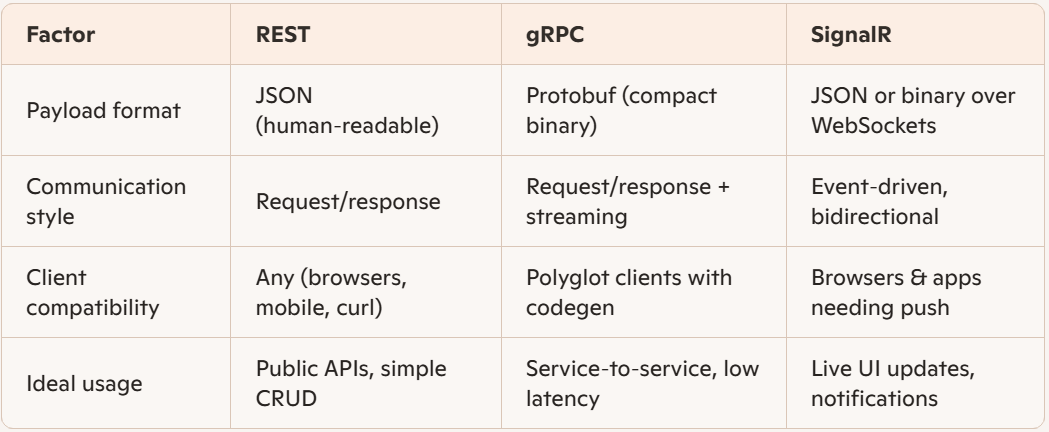
REST — The Most Popular and Simplest One
REST is like sending letters by post
REST is the most widely used backend communication style, mainly because it is simple, familiar, and built on top of HTTP, which the entire internet already understands.
The REST model follows a very straightforward pattern:
Client sends a request
Server processes it
Server sends a response
Connection ends
Each interaction is self-contained.
How REST works (no jargon)
When a frontend calls a REST API:
It sends an HTTP request (GET, POST, PUT, DELETE)
The request contains a URL and optional data
The backend reads the request
The backend performs some logic
The backend sends back a response
The interaction ends
There is no memory of previous requests unless you explicitly build it.
Why REST became so popular
REST didn’t invent new technology.
It simply used what already existed:
HTTP
URLs
browsers
text-based formats like JSON
Because of this:
developers could test APIs in a browser
debugging was easy
logs were readable
tools like Postman worked instantly
This accessibility made REST explode in popularity.
When REST is perfect
REST shines when:
you are building CRUD-based applications
you expose public APIs
readability and simplicity matter
clients vary (web, mobile, third-party)
It is often the first protocol developers learn, and for good reason.
REST limitations
REST is not ideal for everything.
Because it is request–response:
the client must keep asking for updates
the server cannot push data by itself
frequent polling increases load
JSON payloads can become large
As systems became more complex and performance-sensitive, developers started looking for alternatives.
gRPC — When Performance and Efficiency Matter
gRPC is like a high-speed bullet train
gRPC was designed to solve problems REST struggles with, especially in backend-to-backend communication.
Instead of sending readable text like JSON, gRPC uses binary data, which is:
smaller
faster to parse
more efficient over the network
How gRPC works (simple view)
In gRPC:
communication still happens over HTTP
but it uses HTTP/2 instead of HTTP/1.1
data is defined using strict contracts (.proto files)
both client and server generate code from those contracts
This removes ambiguity and reduces errors.
Real-world analogy
REST is like writing letters that anyone can read.
gRPC is like sending compressed files between machines.
Humans prefer letters.
Machines prefer compressed files.
Why companies use gRPC
Companies choose gRPC when:
performance is critical
many services talk to each other
data models must be consistent
network efficiency matters
It is extremely common in:
microservices
internal service communication
cloud-native systems
When gRPC is ideal
gRPC works best when:
clients are known and controlled
both sides are backend services
low latency is important
high throughput is required
Why gRPC is not everywhere
Despite its power, gRPC has drawbacks:
harder to debug manually
not human-readable
not naturally supported by browsers
learning curve is steeper
This is why REST remains dominant for public-facing APIs.
SignalR — When Backend Talks First
SignalR is like a live phone call
REST and gRPC share one limitation:
the client must initiate every request
But many modern applications need:
instant notifications
live updates
continuous data streams
SignalR exists to solve this exact problem.
How SignalR works (simple)
With SignalR:
the client opens a long-lived connection
the connection stays open
the server can send data anytime
the client doesn’t need to ask repeatedly
This enables real-time communication.
Real-world analogy
REST is like checking your phone again and again for messages.
SignalR is like receiving a notification immediately when something happens.
Why SignalR exists
SignalR avoids:
unnecessary polling
wasted network traffic
delayed updates
It creates a smoother user experience.
When SignalR is perfect
SignalR is ideal for:
chat applications
live dashboards
notifications
collaborative apps
real-time monitoring systems
SignalR limitations
SignalR keeps connections open:
which consumes server resources
requires careful scaling
is unnecessary for simple APIs
That’s why it complements REST and gRPC instead of replacing them.
Do other backend communication options exist?
Yes — but they are usually specialized tools, not general-purpose solutions.
GraphQL focuses on flexible queries.
WebSockets provide raw real-time communication.
Message queues enable asynchronous event processing.
SOAP exists mainly for legacy systems.
Each solves a specific problem, but none replace all three major protocols.
Why REST, gRPC, and SignalR dominate
These three dominate because together they cover almost every communication scenario:
REST handles simple request–response APIs
gRPC handles fast internal communication
SignalR handles real-time updates
They are not competitors — they are complementary.
A simple mental map (very important)
Choosing a protocol becomes easy when you ask the right question:
“Do I need simple request–response?” → REST
“Do I need fast service-to-service calls?” → gRPC
“Do I need real-time server push?” → SignalR
Keep the Momentum Going — Support the Journey
If this post helped you level up or added value to your day, feel free to fuel the next one — Buy Me a Coffee powers deeper breakdowns, real-world examples, and crisp technical storytelling.
Final takeaway (for beginners)
Backend communication is not about picking the “best” protocol.
It’s about understanding what kind of conversation your systems need to have.
REST, gRPC, and SignalR exist because:
backend systems evolved
performance needs changed
user expectations grew
Once you understand why they exist, choosing between them becomes natural.