
The Modern Developer Is Not “Just a Coder”
Why a strong developer must think like a Debugger, Business Analyst, QA, and Release Expert

Most developers lose years of growth because they believe one lie:
“My job is to write code. Testing is QA’s job. Requirements are BA’s job. Release is DevOps’ job.”
That mindset creates average developers.
High-value developers don’t work like that. They understand one simple reality:
Software is only valuable when it runs correctly in production and solves the right business problem.
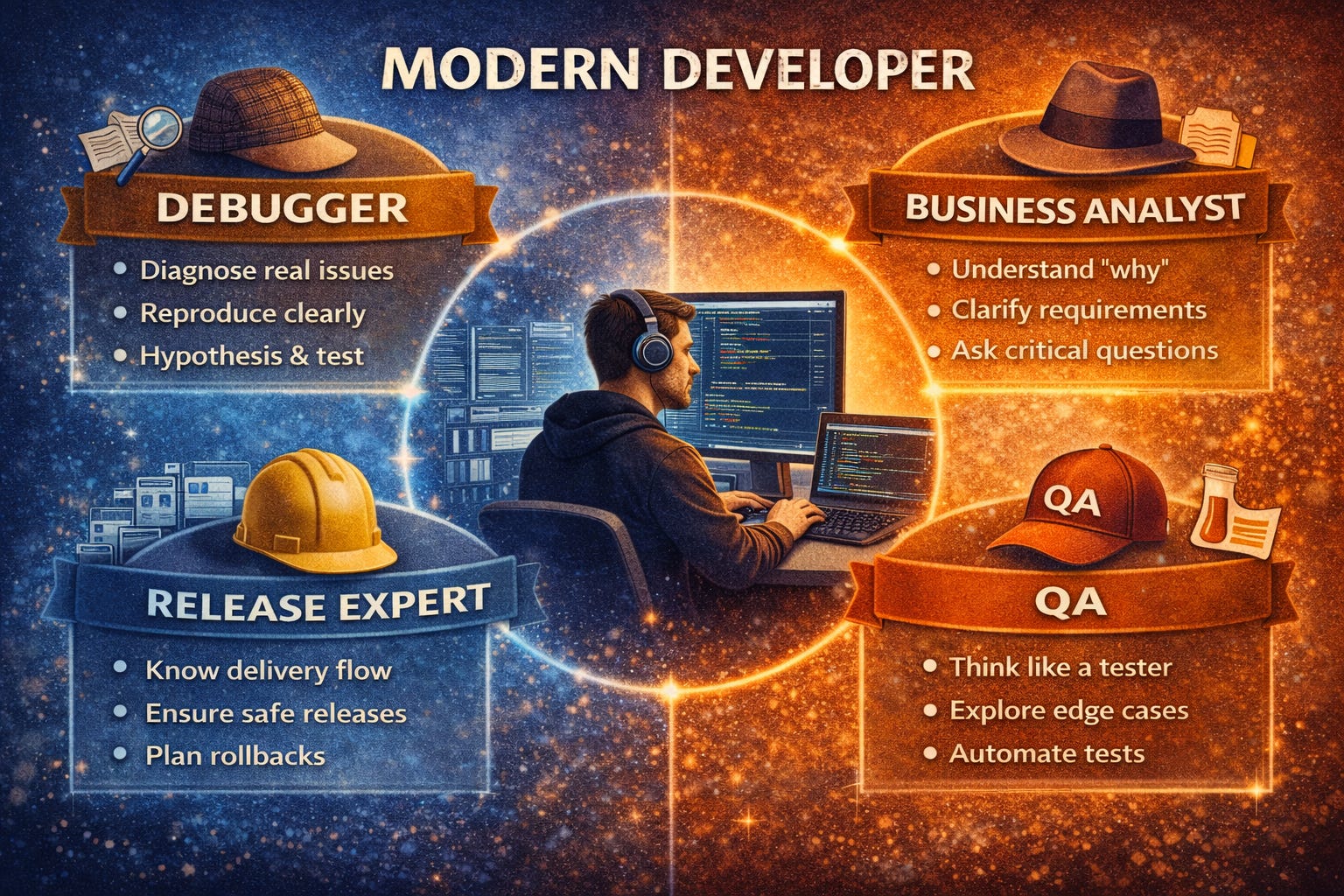
To do that, a developer must wear four hats—whether the org admits it or not:
Debugger
Business Analyst
QA (Quality mindset)
Release Expert (delivery mindset)
This article explains why, and how you can build these skills without becoming “everything everywhere.”
For content overview videos
https://www.youtube.com/@DotNetFullstackDev
1) Developer as a Debugger
Because production doesn’t care about your intentions
Anyone can write code that compiles.
A strong developer writes code that survives reality.
Reality includes:
messy data
unexpected user behavior
slow networks
concurrency issues
timeouts
nulls
partial failures
race conditions
bad deployments
hidden dependencies
When things break, the developer who can debug fast becomes the most valuable person in the room.
What debugging really means (not just breakpoints)
A mature developer uses a layered approach:
A) Reproduce the problem
“When exactly does it happen?”
“Is it consistent or random?”
“Is it environment-specific (prod vs staging)?”
“What input triggers it?”
B) Reduce the scope
isolate the smallest set of conditions to trigger it
remove noise until the problem becomes obvious
C) Observe before changing
logs
metrics
traces
correlation IDs
database queries
upstream/downstream service behavior
D) Hypothesis-driven debugging
Not “try random fixes.”
Instead:
form a hypothesis
test it quickly
confirm/deny with evidence
move to next hypothesis
Mini example (real-life)
Bug report: “Users say checkout fails sometimes.”
Weak developer:
adds a try/catch
retries randomly
ships and prays
Strong developer:
checks payment gateway logs
correlates request IDs
sees timeouts at peak hours
identifies missing timeout policy + circuit breaker
adds proper resilience + observability
writes a regression test
Debugging is not fixing. Debugging is investigation.
2) Developer as a Business Analyst
Because building the wrong thing perfectly is still failure
Many project disasters are not “technical failures.”
They are misunderstanding failures.
A developer who thinks like a BA asks:
“Why are we building this?”
“Who benefits?”
“What does success look like?”
“What are the edge cases?”
“What happens when input is missing?”
“What should happen when a dependency is down?”
The BA mindset developers need
A) Translate business language into system behavior
Business says: “Approve loans faster.”
System reality:
what data is required?
what validations?
what rules?
what exceptions?
what audit logs?
what SLA?
B) Clarify ambiguity early
If requirements have multiple interpretations, don’t code. Clarify.
C) Confirm with examples
Instead of arguing, ask:
“Can you give 3 sample scenarios?”
“What should happen in each?”
Then you convert it to acceptance criteria.
The biggest BA habit: “Definition of Done”
A good developer doesn’t start coding without:
expected input
expected output
error cases
success criteria
non-functional expectations (performance, security)
That’s business analysis inside engineering.
3) Developer as a QA
Because quality is not a department — it’s a mindset
QA is not only about “finding bugs.”
QA is about protecting user trust.
A developer with QA mindset thinks:
“How can this fail?”
“How can a user break this?”
“What assumptions am I making?”
“What happens if dependency returns garbage?”
“What happens under load?”
“What if the clock/timezone changes?”
“What if the user double-clicks 5 times?”
The QA toolbox a developer must own
You don’t need to become a full-time tester. But you must cover quality basics:
A) Unit tests
validate logic
enforce contracts
B) Integration tests
validate database calls
validate external service interactions
validate serialization/deserialization
C) Contract tests (if microservices)
prevent breaking API changes
D) Regression tests
every serious bug gets a test so it never returns
E) Exploratory testing mindset
Before shipping:
try weird inputs
try large payloads
try slow network simulation (where possible)
try “unhappy paths” intentionally
One powerful rule I teach
If you fixed a bug and didn’t add a test, you didn’t really fix it.
You just postponed it.
4) Developer as a Release Expert
Because software doesn’t matter until it’s deployed correctly
Many developers treat release like a ceremony:
“DevOps will handle.”
But production failures often come from:
wrong configuration
missing environment variables
database migration mismatch
connection strings wrong
secrets not set
feature flags misused
backward-incompatible changes
no rollback plan
A release-aware developer prevents these.
Release mindset essentials
A) Know your deployment flow
Even if you don’t run it, understand:
build pipeline stages
artifact creation
environment promotions
approvals
release notes
B) Config discipline
Never hardcode environment-specific values
Use proper configuration providers
Use secrets management
C) Backward compatibility
If you deploy services independently:
database changes must be additive first
APIs must remain compatible
versioning must be planned
D) Rollback readiness
Every release should answer:
“If it fails, how do we rollback?”
“What data changes are irreversible?”
“Do we have feature flags?”
The difference between a coder and an engineer
Coder: “It works on my machine.”
Engineer: “It will survive production, upgrades, failures, and rollback.”
How These Four Hats Work Together (the real picture)
When you combine these skills, you start shipping like a mature engineer:
BA mindset prevents building the wrong thing
QA mindset prevents obvious breakages
Release mindset prevents deployment disasters
Debug mindset reduces MTTR when reality still breaks you
This is how senior developers become “go-to” people.
Not because they write clever code.
Because they deliver reliable outcomes.
Keep the Momentum Going — Support the Journey
If this post helped you level up or added value to your day, feel free to fuel the next one — Buy Me a Coffee powers deeper breakdowns, real-world examples, and crisp technical storytelling.
A Practical Roadmap (so you actually improve)
Week 1–2: Debugging upgrade
Learn logs + correlation IDs
Practice reproducing issues locally
Document your debugging steps like an investigator
Week 3–4: BA upgrade
For every task, write 5 clarifying questions before coding
Convert requirements into “Given / When / Then” scenarios
Week 5–6: QA upgrade
Add unit tests for new work
For every bug fix, add a regression test
Learn integration test basics for your stack
Week 7–8: Release upgrade
Understand your pipeline end-to-end (Jenkins/Azure DevOps/GitHub Actions)
Learn feature flags + config management basics
Learn safe DB migration patterns (expand/contract)
Final Thought
A developer who only codes is easy to replace.
A developer who can:
debug under pressure,
clarify business intent,
protect quality,
and ship safely,
…becomes a force multiplier.
That’s not “extra work.”
That’s what professional software engineering actually is.