
I Thought foreach Was Enough Until My Code Started Waiting… and Waiting… and Waiting

Early in my .NET career, I had a simple belief:
If I have a collection, I loop it.
foreach (var item in items)
{
    Process(item);
}
It was clean.
Predictable.
Easy to reason about.
And for a long time… it was enough.
Until one day, it wasn’t.
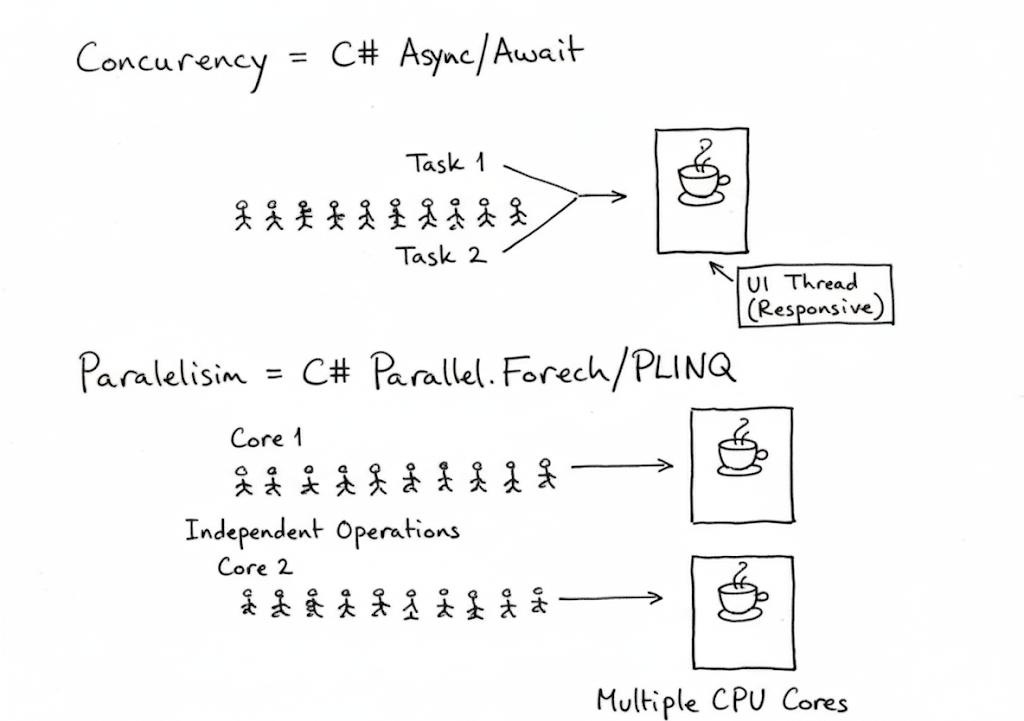
https://www.youtube.com/@DotNetFullstackDev
The First Time “Correct” Code Felt Slow
I remember working on a feature that processed a list of files.
Nothing fancy:
read file
transform data
save output
The code looked fine.
But when the dataset grew, something changed.
It didn’t break.
It just… took forever.
That’s when I first felt the difference between:
code that works
and
code that works under pressure
The Naive Thought: “Let’s Make It Parallel”
The obvious idea came next:
“Why not process multiple items at once?”
That’s when I discovered:
Parallel.ForEach(items, item =>
{
    Process(item);
});
And it felt like magic.
The same logic.
Faster execution.
Problem solved.
At least, that’s what I thought.
When Parallelism Started Breaking Things
Very quickly, subtle issues appeared:
Random exceptions
Data corruption
Race conditions
Inconsistent results
The code didn’t look dangerous.
But it was.
Because I had unknowingly crossed a boundary:
I moved from sequential thinking to concurrent thinking
without changing how I designed my code.
That’s when I realized something uncomfortable:
Parallelism is not just about speed.
It’s about control.
Why foreach Exists (and Why It Still Matters)
Let’s go back for a second.
foreach is not “basic”.
It’s safe by design.
foreach (var item in items)
{
    Process(item);
}
It guarantees:
one item at a time
predictable order
no shared state conflicts (by default)
It’s slow for large workloads, yes.
But it’s calm.
And calm code is easy to trust.
What Parallel.ForEach Really Introduced
Parallel.ForEach didn’t just introduce speed.
It introduced:
multiple threads
non-deterministic execution order
shared state risks
scheduling complexity
Parallel.ForEach(items, item =>
{
    Process(item);
});
Now:
items may run simultaneously
order is not guaranteed
multiple threads can touch the same data
This is where design begins to matter more than syntax.
The First Real Problem: Shared State
Here’s a classic mistake I made:
int total = 0;

Parallel.ForEach(items, item =>
{
    total += item.Value;
});
Looks innocent.
But it’s broken.
Multiple threads updating total at the same time leads to:
lost updates
incorrect results
This is where I first encountered the need for thread-safe constructs.
Enter ConcurrentDictionary — The Controlled Shared State
When multiple threads need to share data, normal collections fail.
That’s where ConcurrentDictionary comes in.
var dict = new ConcurrentDictionary<int, string>();

Parallel.ForEach(items, item =>
{
    dict.TryAdd(item.Id, item.Name);
});
Why this works:
internal locking or lock-free strategies
atomic operations
safe concurrent access
But here’s the deeper realization:
We didn’t just add a new class.
We added discipline to shared data.
But Even That Wasn’t Enough
At some point, I ran into a different problem.
Not just:
“how do I process items faster?”
But:
“how do I coordinate producers and consumers?”
Because now:
one part of the system generates work
another part processes it
And they don’t move at the same speed.
That’s when BlockingCollection entered my world.
BlockingCollection — When Flow Matters More Than Speed
BlockingCollection is not about parallel loops.
It’s about controlled pipelines.
var collection = new BlockingCollection<int>();

// Producer
Task.Run(() =>
{
    foreach (var item in items)
    {
        collection.Add(item);
    }
    collection.CompleteAdding();
});

// Consumer
foreach (var item in collection.GetConsumingEnumerable())
{
    Process(item);
}
What changed here?
producer and consumer are decoupled
consumer waits when no data is available
producer slows down if buffer is full
This is not just concurrency.
This is flow control.
That’s When It Clicked for Me
All these constructs are not random.
They exist because problems evolved.
Let’s map that evolution:
The “Family” (Once It Finally Made Sense)
🟢 foreach
simple iteration
single-threaded
predictable
safe
Used when:
workload is small
order matters
simplicity is priority
🟡 Parallel.ForEach
multi-threaded processing
CPU utilization
faster execution
Used when:
work is independent
no shared state
CPU-bound tasks
🔵 ConcurrentDictionary (and other concurrent collections)
safe shared state
atomic operations
Used when:
threads must share data
consistency matters
Also part of this group:
ConcurrentQueueConcurrentBagConcurrentStack
🟣 BlockingCollection
producer-consumer coordination
backpressure handling
Used when:
pipeline systems
ingestion/processing flows
uneven workloads
And It Still Didn’t End There…
Once I went deeper, I found more tools in this ecosystem:
🔶 Task.WhenAll (async parallelism)
await Task.WhenAll(items.Select(item => ProcessAsync(item)));This is:
asynchronous parallelism
better for IO-bound tasks
Not the same as Parallel.ForEach.
🔷 Parallel LINQ (PLINQ)
var results = items
    .AsParallel()
    .Select(x => Process(x))
    .ToList();
A more declarative way of parallelism.
🔶 Channels (System.Threading.Channels)
Modern alternative to BlockingCollection.
More control.
More performance.
🔷 TPL Dataflow (advanced pipelines)
For complex systems:
multi-stage processing
batching
throttling
So… Why So Many?
This question bothered me for a long time:
“Why doesn’t .NET just give one way to do this?”
Because the problem is not one-dimensional.
Each tool solves a different kind of pain
The Real Answer (The One That Stayed With Me)
This is what finally made everything feel calm:
Concurrency is not a feature.
It’s a set of trade-offs.
Every new construct exists because:
the previous one was not enough
or was too dangerous in certain situations
What Changed in My Thinking
I stopped asking:
“Which one is better?”
And started asking:
“What problem am I actually solving?”
Because:
using
Parallel.ForEachfor IO work is wrongusing
Task.WhenAllfor CPU-heavy loops is inefficientusing shared state without concurrent collections is dangerous
using concurrency when not needed is unnecessary complexity
Final Thought
At first, this ecosystem feels overwhelming.
Too many options.
Too many APIs.
Too many patterns.
But over time, something shifts.
You stop seeing:
different classes
And start seeing:
different responsibilities
And that’s when everything becomes simpler.
If You Remember One Thing
Start simple.
Add concurrency only when pain demands it.
And when you add it, choose the tool that matches the problem — not the trend.
That’s how this evolution makes sense.