
How I Transformed Myself A Senior .NET Engineer Explaining AI — To His Noob Intern

https://www.youtube.com/@DotNetFullstackDev
Sit down.
Close StackOverflow for five minutes.
You asked me yesterday:
“Sir… how did you move from normal backend development into AI systems?
Did you learn machine learning?”
I smiled because every junior asks the wrong question first.
No.
I didn’t learn AI.
I learned where AI fits inside software.
Let me tell you how it actually happened
.
Chapter 1 — The Day I Realized Coding Was Not the Job
When I started my career, I believed software engineering meant writing code.
Controllers.
Repositories.
Stored procedures.
Fixing null reference exceptions at 2 AM.
I optimized queries.
Reduced API latency.
Fought deadlocks.
And I thought:
“This is engineering.”
Then something strange happened.
Every system I built started looking identical.
Different business.
Same architecture.
Controller
 → Service
   → Repository
     → Database
Only nouns changed.
Customer.
Invoice.
Order.
Ticket.
Same patterns.
That’s when I understood something dangerous:
Coding is repetition wrapped in logic.
And repetition is always the first thing automation replaces.
Chapter 2 — The Arrival of the “Alien Words”
Then came the meetings.
Someone said:
LLM
GPT
Agents
Embeddings
AI workflows
Half the room nodded confidently.
The other half Googled secretly.
I was in the second half.
It sounded like the industry suddenly switched from C# to astrophysics.
My first instinct?
Ignore it.
Exactly like senior developers ignored:
async/await
cloud computing
containers
History repeats.
Chapter 3 — My First Mistake
I tried learning AI the wrong way.
I opened YouTube.
Suddenly I was watching:
neural networks
gradient descent
backpropagation
tensor mathematics
After two days I closed everything.
Because I realized:
This is not my layer.
A database engineer doesn’t build SSD firmware.
A web developer doesn’t design TCP/IP.
Why was I trying to become an AI researcher?
Wrong abstraction level.
Chapter 4 — The Moment Everything Clicked
One evening I asked a different question.
Not:
“How does AI work?”
But:
“How would I integrate this into an ASP.NET application?”
That changed everything.
Because suddenly AI looked familiar.
It wasn’t intelligence.
It was an API.
Just another dependency.
Like SQL Server once was.
Chapter 5 — My First Real Experiment
I wrote a tiny endpoint.
POST /summarizeInput:
A long document.
Backend:
Call LLM API.
Return:
Summary.
That’s it.
No magic.
But something felt different.
For the first time…
My API wasn’t executing logic.
It was reasoning.
And I realized:
The future backend doesn’t just process data.
It interprets intent.
Chapter 6 — Understanding the True Role of a Developer
Listen carefully.
AI doesn’t remove engineering.
It moves responsibility upward.
Earlier, I decided:
how data flows
how logic executes
Now I decide:
what AI is allowed to do
what AI must never do
how outputs are validated
how decisions are audited
The LLM became junior.
I became architect again.
Chapter 7 — The Agent Revelation
You know what an AI Agent really is?
Not Jarvis.
Not consciousness.
It’s this:
while(goalNotAchieved)
{
    DecideNextStep();
    ExecuteTool();
    ObserveResult();
}
That’s it.
A loop.
We’ve written this our entire careers.
Background workers.
Schedulers.
Workflow engines.
Only difference?
Decision-making moved from if-statements to probability.
Chapter 8 — The Hard Lesson
My first agent failed spectacularly.
It called tools endlessly.
Generated nonsense.
Burned API credits.
I learned something critical:
AI without guardrails behaves like an infinite while loop.
So I added:
step limits
schema validation
tool allowlists
timeout policies
audit logging
Suddenly the system stabilized.
Not because AI improved.
Because engineering improved.
👉I’ve shared the JWT Authentication Boilerplate for ASP.NET Core (.NET 8)
(Instant download, production-ready, no fluff)
Chapter 9 — The Biggest Mindset Upgrade
Junior developers think AI writes software.
Experienced developers realize:
AI increases the importance of architecture.
Because now systems must handle uncertainty.
You don’t trust outputs blindly.
You design verification layers.
Like input validation evolved into output validation.
Chapter 10 — When I Became AI-Augmented
The transition wasn’t dramatic.
No certification.
No career switch.
One day I noticed:
Instead of asking,
“How do I code this feature?”
I asked,
“Should this be deterministic logic or probabilistic reasoning?”
That question changed my design decisions forever.
Some problems belong to code.
Some belong to AI.
Knowing the difference is the new seniority.
Chapter 11 — What I Told My Team
I gathered juniors and said:
Stop fearing AI.
You already know 80% required skills:
APIs
scalability
observability
security
async workflows
distributed systems
AI engineers without backend knowledge struggle.
Backend engineers who learn AI orchestration thrive.
Chapter 12 — The Truth Nobody Says
AI will not replace developers.
But developers who only translate requirements into CRUD APIs?
Yes.
Because that layer is automatable.
The future developer designs systems where:
humans define goals
AI proposes solutions
software enforces correctness
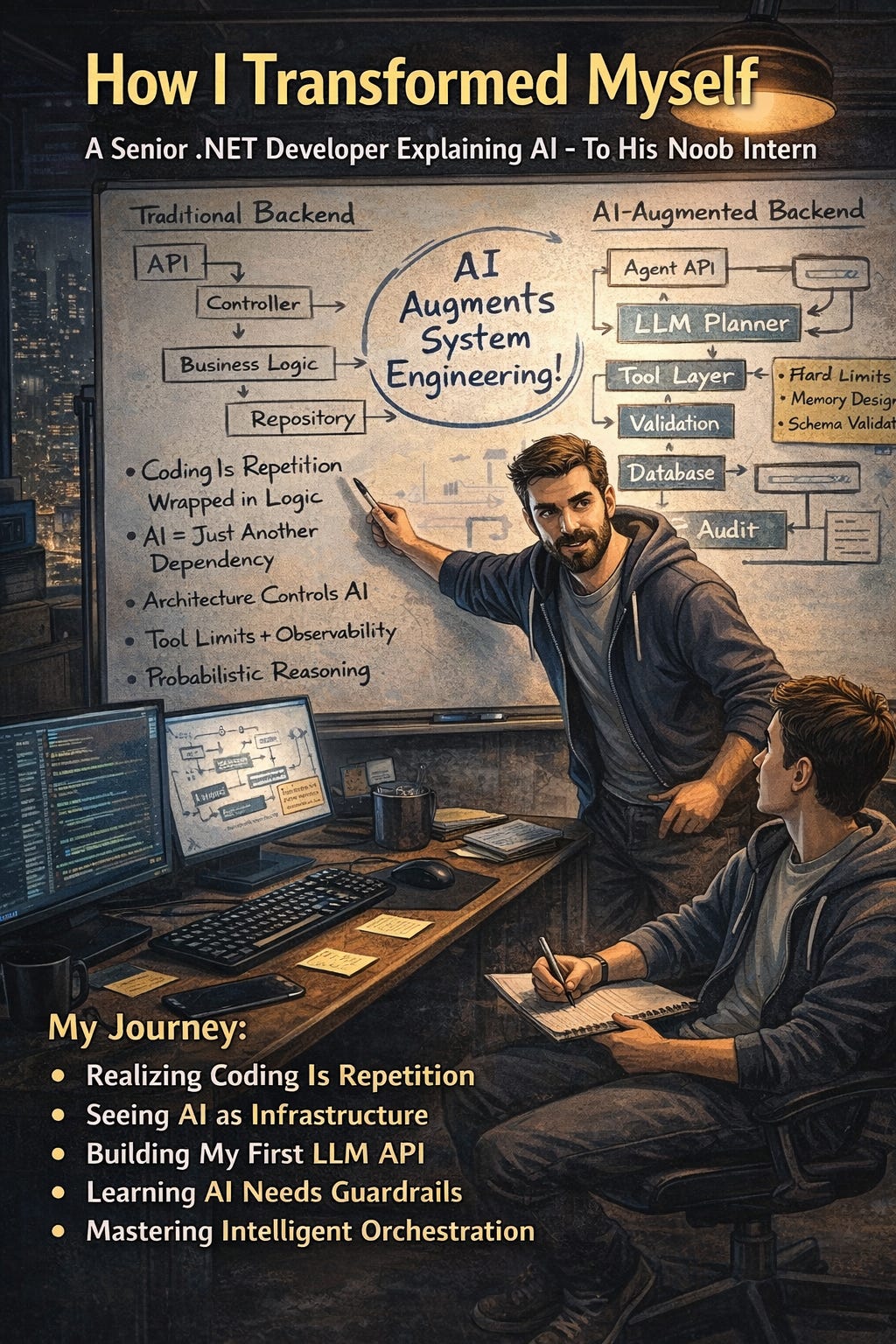
Chapter 13 — My New Architecture Diagram
Earlier:
User → API → Business Logic → DBNow:
User
 → API
 → AI Planner
 → Tool Layer
 → Validation
 → Database
 → Audit
Same foundation.
Higher abstraction.
Chapter 14 — What I Actually Learned
Not AI.
I learned:
uncertainty engineering
intelligent orchestration
system supervision
probabilistic integration
AI didn’t replace my skills.
It amplified them.
Chapter 15 — What I Want You To Understand
You don’t transition by abandoning .NET.
You transition by asking:
Where should intelligence live in my system?
Once you see that…
AI stops being alien.
It becomes another service.
Another dependency injection.
Another architectural decision.
Keep the Momentum Going — Support the Journey
If this post helped you level up or added value to your day, feel free to fuel the next one — Buy Me a Coffee powers deeper breakdowns, real-world examples, and crisp technical storytelling.
Final Words (From Senior to Intern)
You asked how I transformed myself.
I didn’t chase AI.
I expanded my definition of software.
The compiler still runs.
The API still scales.
The database still persists.
But now…
My systems can reason.
And I remain the engineer controlling them.