
Are Design Patterns, Clean Architecture, and System Design Dead?
If AI Already Knows Everything, Why Should Developers Learn It?

https://www.youtube.com/@DotNetFullstackDev
There’s a quiet fear moving through development teams.
It’s not loud.
It’s not dramatic.
But it’s there.
You can feel it in conversations.
“AI can generate clean architecture.”
“AI knows all design patterns.”
“AI can design scalable systems.”
And then comes the real question:
If AI is preloaded with patterns and architectures…
Why should I memorize Singleton, Factory, CQRS, DDD, Clean Architecture, or CAP theorem?
Let’s answer this honestly.
Not defensively.
Not emotionally.
But structurally.
AI Knows Patterns. It Does Not Understand Trade-offs.
This is the first distinction developers must internalize.
AI has seen:
Millions of examples of Repository pattern
Thousands of Clean Architecture implementations
Countless microservice templates
Infinite Singleton mistakes
It can reproduce patterns.
But reproduction is not judgment.
When you design a system, you are not selecting patterns because they exist.
You are selecting patterns because:
You understand constraints.
You understand failure modes.
You understand scale.
You understand domain complexity.
You understand operational cost.
AI suggests patterns based on statistical frequency.
Architects choose patterns based on contextual necessity.
That difference is everything.
Memorizing Patterns Is Not About Recall. It’s About Mental Models.
Let’s be honest.
No senior engineer memorizes patterns like flashcards.
They internalize mental models.
When a senior hears:
“High read, low write, multi-region system with eventual consistency.”
Their brain automatically activates:
Caching strategy
Read replicas
CQRS possibility
Event-driven architecture
CAP trade-offs
Idempotency design
That reflex does not come from memorization.
It comes from structured understanding.
AI cannot replace your mental model.
It can only generate based on its training.
Without internal mental models, you cannot evaluate AI’s output.
AI Is a Pattern Reproducer. Developers Are Context Interpreters.
Let’s compare.
AI:
Detects pattern similarity
Generates common architecture
Suggests typical solutions
Developer:
Evaluates non-functional requirements
Considers team skill level
Accounts for deployment constraints
Predicts operational burden
Assesses long-term maintainability
Evaluates organizational culture
Architecture is not just technical.
It is organizational.
AI cannot read your org chart.
Clean Architecture Is Not Code Structure. It’s Responsibility Separation.
AI can generate a Clean Architecture folder structure.
It cannot ensure:
Proper dependency direction
Business logic isolation
Domain purity
Real boundary enforcement
Team discipline over time
Clean Architecture is less about code and more about thinking.
Without understanding dependency inversion, AI-generated layers become cosmetic.
And cosmetic architecture collapses under complexity.
System Design Is Decision-Making Under Uncertainty
System design exists because of trade-offs.
Latency vs consistency.
Cost vs scalability.
Simplicity vs flexibility.
Performance vs readability.
AI can suggest a “scalable architecture.”
But scalable for:
1,000 users?
1 million users?
Global?
Real-time?
Batch?
Regulated industry?
AI does not own consequences.
Architects do.
That is why system design cannot disappear.
The Illusion of “Preloaded Knowledge”
Yes, AI has been trained on:
Martin Fowler
Uncle Bob
Microsoft docs
StackOverflow
GitHub repositories
But knowledge is not ownership.
AI doesn’t:
Refactor your production monolith safely
Debug your memory leak in staging
Sit through incident postmortems
Feel SLA pressure
Answer to executives when systems fail
Architecture knowledge matters because consequences are real.
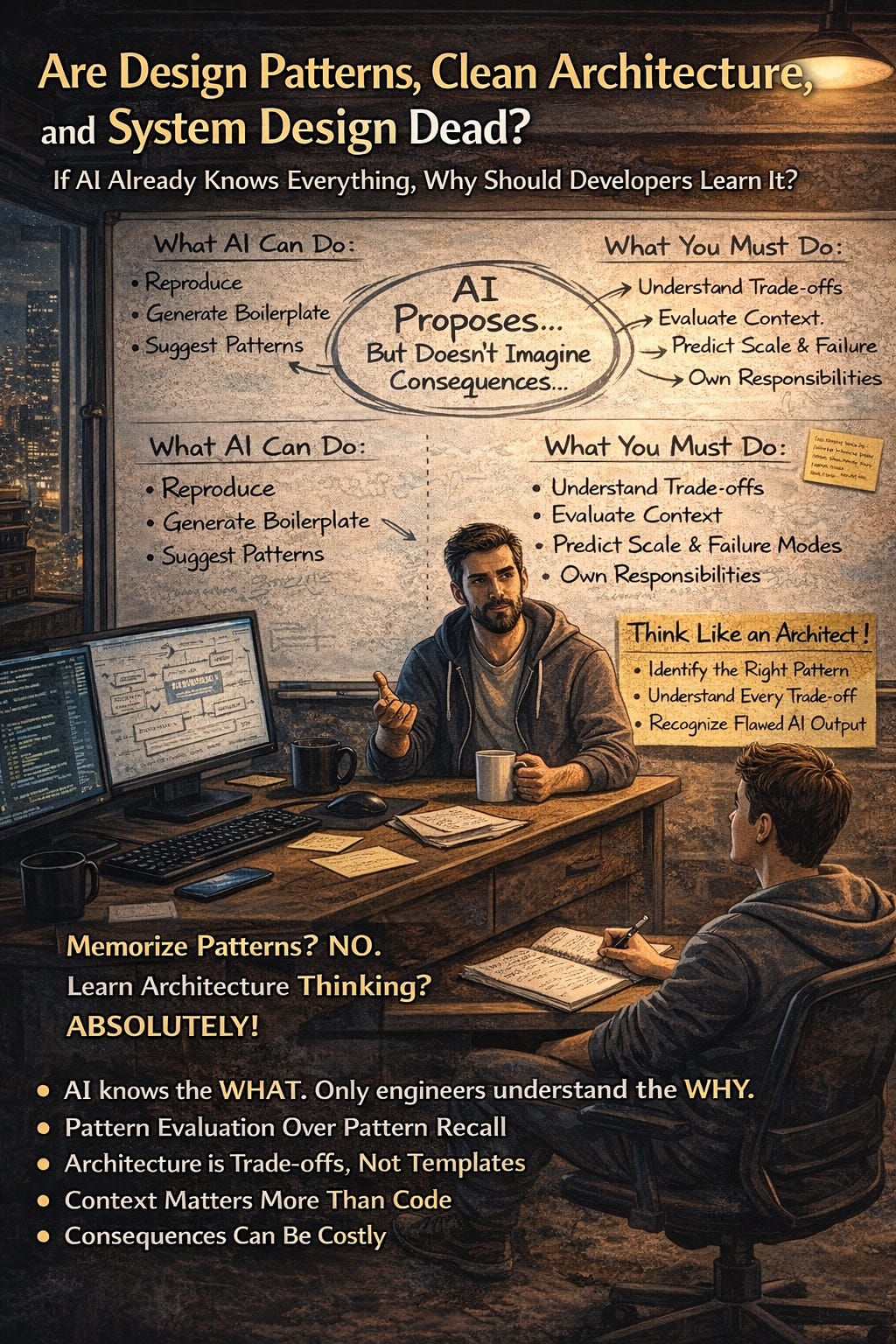
Why Developers Still Need to Learn Design Patterns
Because patterns are not templates.
They are:
Reusable solutions to recurring problems
Vocabulary for technical communication
Shared understanding across teams
Conceptual compression tools
When you say:
“Let’s apply Strategy pattern here.”
You compress an entire explanation into two words.
If you rely only on AI and never internalize patterns:
You cannot communicate at that abstraction level.
And communication is seniority.
AI Amplifies Good Architects. It Exposes Weak Ones.
Here is the uncomfortable truth.
AI will not replace strong architects.
It will expose shallow ones.
If you don’t understand:
Thread safety
Transaction boundaries
Data consistency
Domain modeling
SOLID principles
You cannot detect when AI gives you a flawed design.
You will accept incorrect patterns confidently.
And that is more dangerous than ignorance.
The Real Shift: From Pattern Recall to Pattern Evaluation
In the AI era, developers do not need to memorize every pattern detail.
But they must:
Recognize patterns
Understand trade-offs
Evaluate applicability
Modify for context
Reject inappropriate suggestions
AI proposes.
Architects dispose.
The Role of AI in Modern Architecture
AI becomes:
Idea generator
Boilerplate accelerator
Edge-case enumerator
Documentation summarizer
Alternative approach suggester
But AI is not:
Risk owner
Accountability bearer
Context interpreter
Long-term maintainer
Architecture survives because responsibility survives.
What Happens If You Stop Learning Patterns?
You become dependent.
Dependent engineers:
Cannot evaluate suggestions
Cannot design from first principles
Cannot debug architectural failures
Cannot scale systems independently
Cannot lead technical decisions
You become an operator, not an engineer.
And operators are automatable.
What Actually Changes in the AI Era
Earlier:
You memorized patterns to recall them manually.
Now:
You learn patterns to validate AI output.
The reason changes.
The necessity does not.
Architecture Is Thinking, Not Syntax
Clean architecture is not about folder structure.
It is about:
Separation of concerns
Dependency flow
Domain independence
Boundary protection
Future-proofing
AI can scaffold layers.
Only engineers protect boundaries.
Final Perspective
Design patterns are not dying.
They are becoming more important.
Because in a world where AI generates code instantly:
The ability to judge architecture becomes the differentiator.
The question is not:
Does AI know design patterns?
The question is:
Do you know enough to recognize when AI misapplies them?
And that, my friend, is what keeps developers relevant.